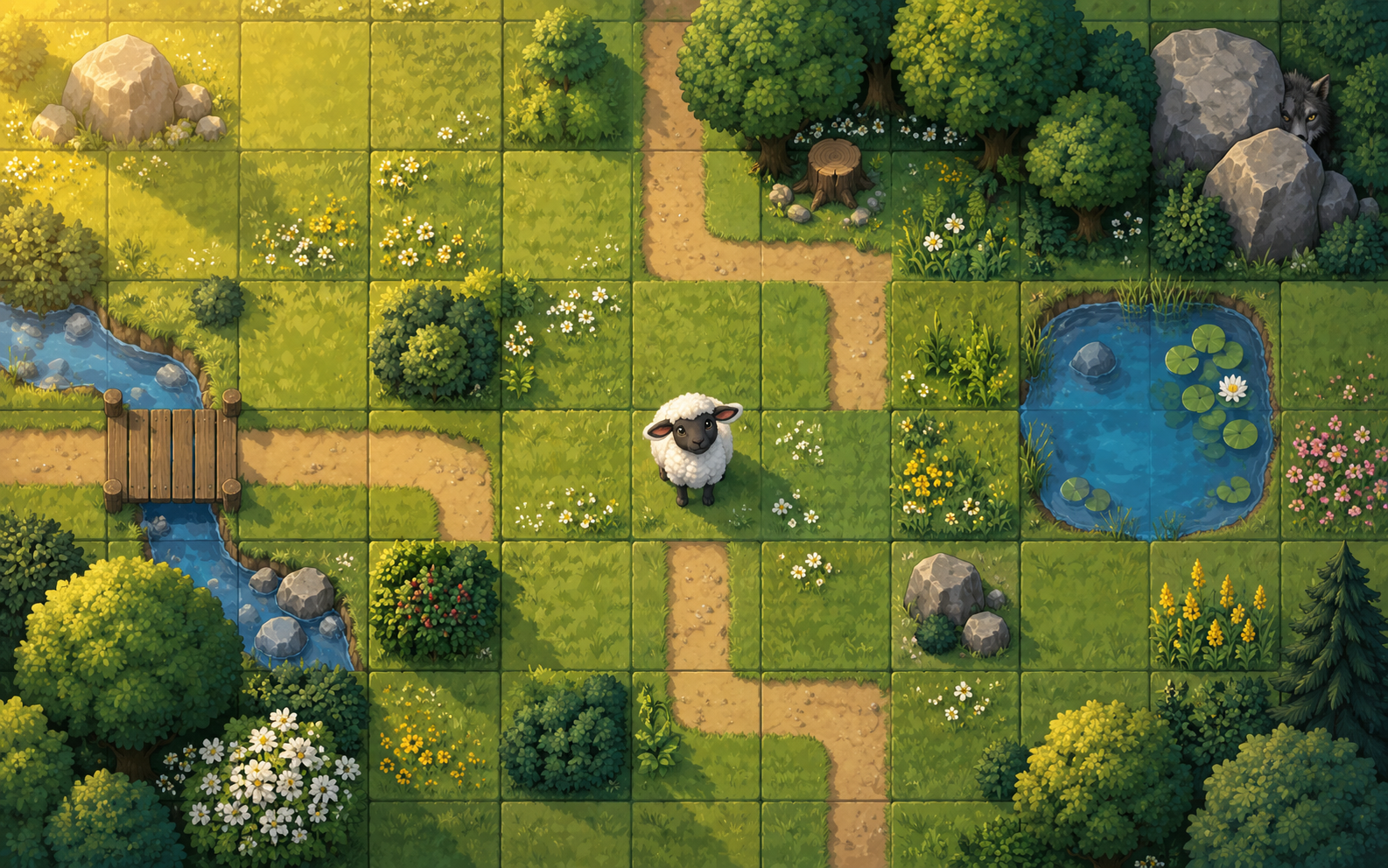
What the child sees
The whole screen
A pond to the east. Grass nearby. A wolf peeking from behind a rock.
A thinking lab for the AI era
In a little living world, learners imagine how Daisy should behave, express the idea in their own words, approve what the AI understood, predict what will happen, and test their own design against a world that keeps moving. AI lowers the syntax barrier; the learner remains the architect.
Imagine. Express. Confirm. Predict. Test. Refine.
The Human Thinks.
The AI Translates.
The Turtle Teaches How to Think.
Daisy Executes.
The World Responds.
The system gives Daisy abilities: to move, sense, remember, and act. The learner alone designs her strategies — whether the idea is expressed in natural language, blocks, pseudocode, or Scheme. AI may translate and expose ambiguity, but it may not invent goals, conditions, priorities, or shortcuts. Daisy is deliberately vulnerable, so the question changes from “Which command moves her?” to “What strategy will help her live well — and why?”
What the child sees
A pond to the east. Grass nearby. A wolf peeking from behind a rock.
What Daisy knows
Vision can be blocked. Sound has a radius. Smell is a gradient. The map is not her knowledge.
“The program is not the answer. It is the hypothesis.”
The learner creates the hypothesis. AI can translate it. The world returns the evidence.
Every run is an experiment owned by the learner. The AI makes an interpretation explicit, returns meaningful ambiguity to the human, and nothing becomes part of Daisy’s brain until the learner approves it.
Separate the world from the evidence Daisy can sense, then decide what that evidence means.
Design the strategy, break it into small functional ideas, and express those ideas in your own words.
Resolve ambiguity yourself, approve the explicit meaning, and state what should happen before the world runs.
Treat success, failure, and surprise as evidence; explain the causal trace and change the model for a reason.
The sun rises. Seasons turn. Rain changes conditions. Water matters. Wolves move. Even when Daisy waits, the world continues — because good thinking must work inside a system, not outside it.
One world second
A tiny decision.The same Daisy, the same world, and the same mind move from guided discovery, through experiment, into autonomous life.
01
Short guided scenarios begin with a situation in Daisy’s world — not with a language feature. Logo’s turtle teaches how to think by asking about goals, conditions, ambiguity, exceptions, and predictions. It never supplies the strategy or solves the active scenario.
“Before Daisy moves east, what should she know?”
THE THINKING CYCLE See→Understand→Think / plan→Express→Clarify & confirm→Predict→Run→Observe→Explain→Refine
In the planned interface, natural language becomes the front door, not a back door for AI-authored strategy. The learner writes the idea; AI returns an explicit interpretation, reveals ambiguity, and waits for approval. Underneath, small composable functions — and Lambda — remain the LEGO-like bricks of Daisy’s brain. Blocks, pseudocode, and Scheme remain equivalent views of the same approved meaning.
GOAL       Find water safely
UNKNOWN    What counts as “safe”?
WAIT Ask the human(compose
sense-danger
find-water
avoid-recent-danger)Free expression at the door. Functional bricks underneath. Human authorship throughout.
The long view
LambDaisy asks how people can develop systems thinking by constructing the mind of an autonomous creature in a persistent world. In the future, the same personal brain may meet increasingly demanding worlds, climates, resources, and fair, sense-able hazards — not to receive a smarter brain, but to reveal what the learner wants to rethink. These are future research directions, not current simulator features.
We don’t use AI to replace human thinking. We use AI to open new possibilities for human thinking.